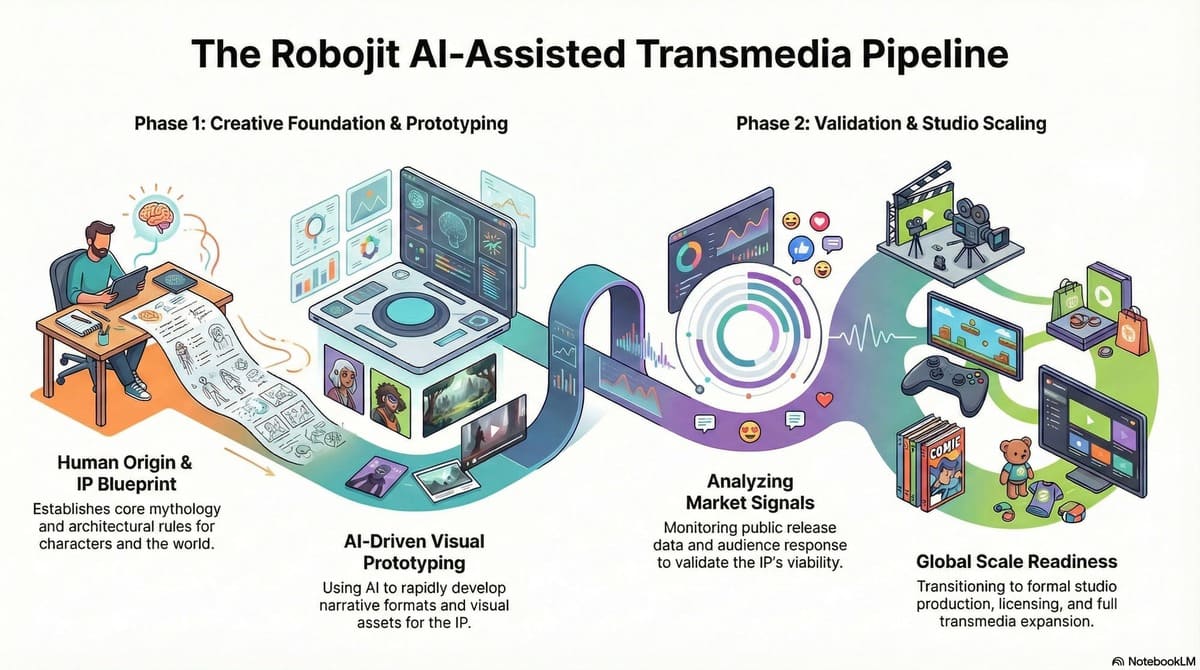
Robojit’s AI-Assisted Production Pipeline
The objective is not simply to build one science-fiction universe, but to demonstrate a repeatable, AI-assisted production model that can be applied to future storytelling projects.
Robojit and the Sand Planet began as a human-written science-fiction novel, created long before artificial intelligence tools entered mainstream creative workflows. The story, characters, and mythology originate entirely from that original work and remain the creative foundation of the project.
What has evolved over time is not the story’s origin, but the way the story is developed, visualized, tested, and expanded.
Today, Robojit is being built as a global transmedia project using an AI-assisted production pipeline — a structured, step-by-step process that treats storytelling more like a manufacturing system than a one-time artistic gamble. The aim is to reduce costs, accelerate experimentation, and prepare the project for multiple formats while preserving creative intent at the source.
At the core of this pipeline is the principle that human authorship comes first. The novel defines the world, the characters, and the themes. AI tools are applied only downstream, where they help translate that creative core into visual, narrative, and distribution-ready forms.
Once the original story exists, it is formalized into an IP blueprint. This stage defines how the Robojit universe works — character relationships, world rules, narrative continuity, and thematic boundaries. By structuring the story world as intellectual property rather than a single-format work, Robojit becomes adaptable to film, animation, graphic novels, articles, videos, and international editions without losing coherence.
AI tools are then introduced at the prototyping stage, where they offer the greatest value. Visual concepts, screenplay excerpts, graphic novel layouts, explainer visuals, and localized materials can be produced quickly and affordably. Instead of committing large budgets to traditional pre-production, ideas are tested early, iterated rapidly, and refined based on real outputs.
These prototypes are not created in isolation. They are released publicly across platforms — on the Robojit website, in articles, visual previews, and international language editions. Each release functions as a market signal, offering insight into audience interest, platform response, and format resonance. Feedback is observed in real time, allowing the project to evolve based on evidence rather than speculation.
Only after this stage does the project move toward scale readiness. By then, the story world is already defined, visual language explored, and audience response measured. This makes the project far better prepared for studio partnerships, co-production models, licensing, or long-form development in film, animation, or series formats.
In this way, Robojit operates as a living system. Every new image, article, video, screenplay excerpt, or graphic novel page is both a creative artifact and a validation of the production pipeline behind it.
The objective is not simply to build one science-fiction universe, but to demonstrate a repeatable, AI-assisted production model that can be applied to future storytelling projects. Robojit is the proof — evolving in public, step by step, from a single novel into a scalable transmedia intellectual property.
For readers interested in the broader industry context and the implications of this approach for film and entertainment, a detailed analysis of the production pipeline is also available on RMN Stars.
Robojit Website | IMDb | FilmFreeway | ISA | YouTube | Twitter (X) | Facebook